Wednesday, December 23, 2015

ELEPHANT TERRACE

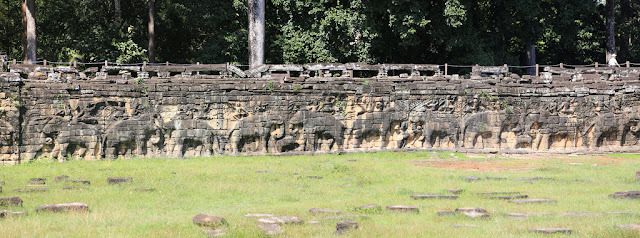
The Terrace of the Elephants is part of the walled city of Angkor Thom, a ruined temple complex in Cambodia. The terrace was used by Angkor's king Jayavarman VII as a platform from which to view his victorious returning army. It was attached to the palace of Phimeanakas, of which only a few ruins remain. Most of the original structure was made of organic material and has long since disappeared. Most of what remains are the foundation platforms of the complex. The terrace is named for the carvings of elephants on its eastern face.
 
The 350m-long Terrace of Elephants was used as a giant reviewing stand for public ceremonies and served as a base for the king's grand audience hall. It has five outworks extending towards the Central Square-three in the Centre and one at each end. The middle section of the retaining wall is decorated with life size garuda and lions; towards either end are the two parts of the famous parade of elephants complete with their Khmer mahouts.


Source: wikipedia.org

BAKSEI CHAMKRONG

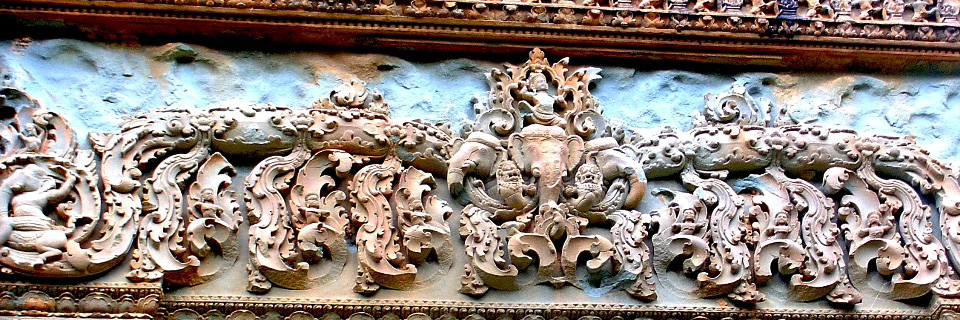
Indra on Airavata, with Ganesh riding his trunk on either side, at Baksei Chamkrong, Siem Reap, Cambodia
 Baksei Chamkrong is a small Hindu temple located in the Angkor complex (Siem Reap, Cambodia). It is dedicated to Lord Shiva and used to hold a golden image of him. The temple can be seen on the left side when entering Angkor Thom at the southern gate. It was dedicated to Yasovarman by his son, King Harshavarman I. The temple was completed by Rajendravarman II (944-968).

He name Baksei Chamkrong means "The Bird Who Shelters under Its Wings" and comes from a legend. In it, the king tried to flee Angkor during a siege and then a huge bird landed and sheltered him under its wings.


 This temple is one of the first temples constructed of durable material such as bricks and laterite and with decoration in sandstone. Much of the stucco on the surface of the temple has vanished. The main sandstone lintel is decorated with a fine carving of Indra standing on his three-headed elephant Airavata. Garlands emanate from either side of Indra in the style current to the monument. There is an inscription on either side of the small doorway.
The pyramid measures 27 metres across at the base and 15 at the summit for an overall height of 13 metres.

PHNOM BAKHENG

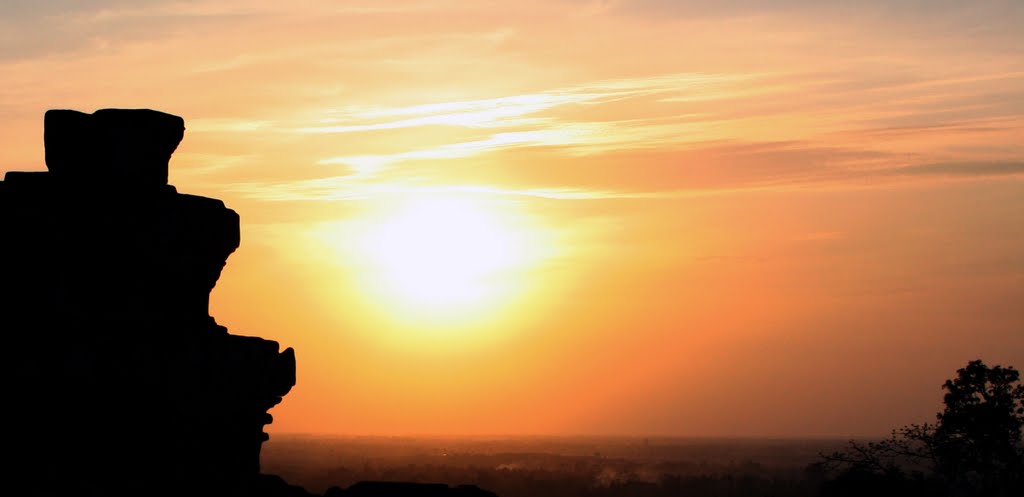
   Phnom Bakheng Temple is at Angkor Area, Cambodia, is a Hindu and Buddhist temple in the form of a temple mountain. Dedicated to Shiva, it was built at the end of the 9th century, during the reign of King Yasovarman (889-910). Located atop a hill, it is nowadays a popular tourist spot for sunset views of the much bigger temple Angkor Wat, Every day have a lot of tourism claim up to watching Sunset at the temple on top the Bakheng Mountain, which lies amid the jungle about 1.5 km to the southeast. The large number of visitors makes Phnom Bakheng one of the most threatened monuments of Angkor. Since 2004, World Monuments Fund has been working to conserve the temple in partnership with APSARA.

   Constructed more than two centuries before Angkor Wat, Phnom Bakheng was in its day the principal temple of the Angkor region, historians believes. It was the architectural centerpiece of a new capital, Yasodharapura that Yasovarman built when he moved the court from the capital Hariharalaya in the Roluos area located to the southeast.

   
An inscription dated 1052 AD and found at the Sdok Kak Thom temple in present-day Thailand states in Sanskrit: "When Sri Yasovardhana became king under the name of Yasovarman, the able Vamasiva continued as his guru. By the king's order, he set up a linga on Sri Yasodharagiri, a mountain equal in beauty to the king of mountains. Scholars believe that this passage refers to the consecration of the Phnom Bakheng temple approximately a century and a half earlier.

   Surrounding the mount and temple, labor teams built an outer moat. Avenues radiated out in the four cardinal directions from the mount. A causeway ran in a northwest-southeast orientation from the old capital area to the east section of the new capital's outer moat and then, turning to an east-west orientation, connected directly to the east entrance of the temple.
Phnom Bakheng is a symbolic representation of Mount Meru, home of the Hindu gods, a status emphasized by the temple’s location atop a steep hill 65 m above the surrounding plain. The temple is built in a pyramid form of seven levels, representing the seven heavens. At the top level, five sandstone sanctuaries, in various states of repair, stand in a quincunx pattern one in the center and one at each corner of the level’s square. Originally, 108 small towers were arrayed around the temple at ground level and on various of its tiers; most of them have collapsed.
   Phnom Bakheng is one of three hilltop temples in the Angkor region that are attributed to Yasovarman's reign. The other two are Phnom Krom to the south near the Tonle Sap Lake, and Phnom Bok, northeast of the East Barayreservoir.

Following Angkor's rediscovery by the outside world in the mid-19th century, decades passed before archeologists grasped Phnom Bakheng's historical significance. For many years, scholars' consensus view was that the Bayon, the temple located at the center of Angkor Thom city, was the edifice to which the Sdok Kak Thom inscription referred. Later work identified the Bayon as a Buddhist site, built almost three centuries later than originally thought, in the late 12th century, and Phnom Bakheng as King Yasovarman's state temple.

Source: wikipedia.org

Monday, December 21, 2015

WEST BARAY


East-west is located just west of the walled city of Angkor Thom. Rectangular in shape, it measures about 8 km long and 2.1 km wide, making it the largest baray at Angkor. Its waters are contained by tall earthen dikes. The center of the baray is the artificial island of Western Mebon, where a Hindu temple is built.
The construction of the baray probably began in the eleventh century under the reign of King Suryavarman I and was completed under the reign of King Udayadityavarman II.

Angkor engineers who created the Western Baray seem to have used elements of the existing site buildings. Is the dam seems to be largely a section of a dike surrounding the capital of King Yasovarman which was built in the center of the temple of Phnom Bakheng. In other places, the construction of the baray resulted burial or submersion other sites. South dike and partially buried temple Ak Yum pyramidal and built of brick. The western baray appears to have been formerly inhabited archaeological research have indeed unearthed in the area of the bases of walls, stairs and shards of pottery and a stone engraved dating from 713 AD which provides an overview how were delimited fields of rice were offered a queen Jayadevi.

In the early excavations, French archaeologists believed that the Western Baray functioned as a vast reservoir of water retention for powering irrigation canals in times of drought, thus multiplying rice crops each year. More recent studies, however, theorize that the Baray had mainly symbolic function, acting as an earthly representation of the primordial ocean, with the Western Mebon temple at its center.


In modern times, a valve was built on the south dike of the baray, thus raising the water level and water supply to the fields of the south. Today the baray not retain water throughout the year in its western end. During the rainy season, however, the water advances to the eastern breakwater.

Baray waters, clear and calm, made it a place frequented by locals, for swimming and boating. The body of water was also used occasionally landing site for seaplanes.

MY TRIP AT SIEM REAP TOWN AFTER ANGKOR WAT TEMPLE

It was a week into my time at Siem Reap when we were all sitting around the hostel bar, and the topic Angkor Wat came up. I mean of course it did, how it could not, after all we were sitting 20km away from the ancient temples, drinking Angkor Beer. It was then that I realized I had been in Siem Reap a full week without seeing what has been dubbed the 8th wonder of the world, Angkor Wat. My fellow travellers couldn't believe it, for sure I was bluffing, but I wasn't. At that point the question arose, what did I do for a week in Siem Reap?

Vegetables's Farmer 


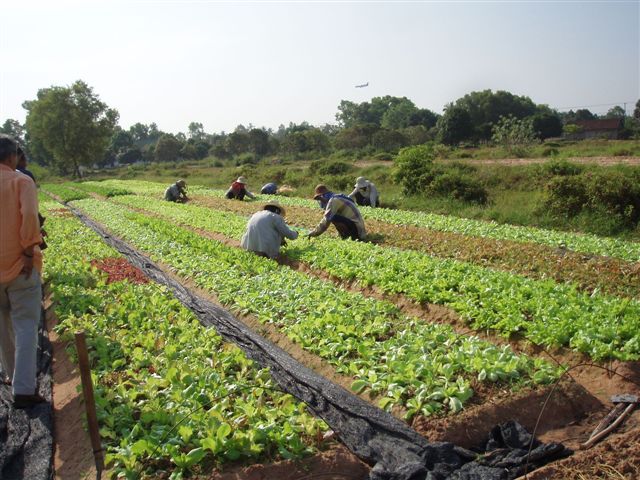
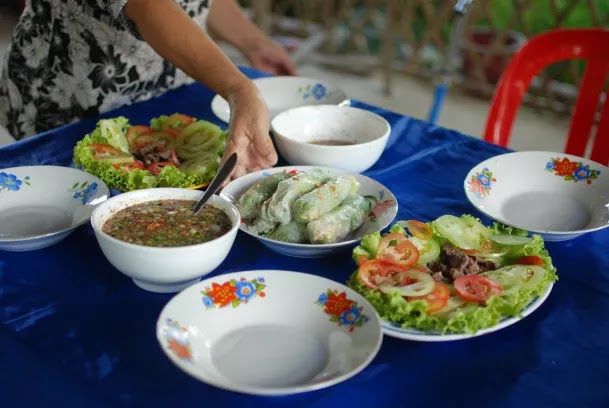
The simple of it would be that I hung out with the nicest people I've ever met, Cambodians! However, the nicest Cambodians are found in the country side and the villages. These people truly are genuine; they value their quality of life more than trying to get rich quick. Rich obviously being a loosely used term here, as most Cambodians make around a $1000 a year. The ones that haven't decided to move to the city still make it by farming their own food and trading it amongst the village people. Working by sunrise and drinking rice wine by day, and early to bed at night. One of my best days in Cambodia was when I took a trip out to a village and visited with true Cambodian's for the day. Cooking fish and beef on an open fire, next to a fresh water reservoir where the locals fish and take fresh afternoon dips to cool off! Furthermore they showed us their farm, their techniques, their home and introduced us to their family, making us all feel extremely blessed.

Growing the Rice
The town of Siem Reap is also the perfect place to be at any time of day. With the French influence here, there's always a coffee shop, or a baguette for 25 cents nearby. Bustling bars line every street here, not just on Pub Street! The locals are always keen for a game of pool or snooker at one of the many snooker halls, or on one of the many bars if your lucky enough to score a table. Or why not grab an ice cream cone from Swensens' ice cream (the best in town) and head out on a river stroll towards where the locals play beach volleyball. The fast paced game, of the highly talented locals will keep you on your toes, or maybe you even want to join in and play on one of the many courts available. Looking for more sporting opportunities, well Siem Reap is also home to Cambodia's only climbing gym. Not quite your pace? Maybe try heading back across the river towards "Common Ground" an American owned coffee shop with a good cause. The prices are a little hefty, but with every $1000 of profit they're able to build a house in a new city located in Khan Dang Kao. Cambodia's poorest area where 1500+ families are living in extreme poverty, It's a $1.50 for an ice coffee, a buck for a small bottle of water or more than I care to admit paying, $2 for a large bottle of water. I went for the molten lava cake, a rich chocolate dish topped with whip cream, that ran me a well worth it $2.


Then I'm sure 0.75 cent draft Beer at one of the many pubs on Pub Street will do you well! Bustling bars line every street here, more than just on Pub Street! The locals are always keen for a game of pool or snooker at one of the many snooker halls, or at one of the bars if your lucky enough to score a table. Some places serve 50 cent draft through all hours of the night, but most backpackers tend to head towards the famous "Angkor what" bar, the bar that started it all back in 1998. Here you can meet countless other like-minded travelers, eager to tell their stories and hear yours. It's no longer 1998 anymore, nowadays there's plenty more late night bars for you to check out as well. Temple bar is across the street, and is the place to go for a late night meal, since their kitchen never closes. Down the street is X bar, an Australian ran rooftop bar with a half pipe at the top! Yes! A half pipe, even if you don't have your own board (since I'm yet to meet someone who travels Asia with a skateboard) you can rent one for 5 bucks and they'll throw in a pint with it! More options include Tuk Tuk Bar, Laundry Bar, Mezze bar, Miss Wongs Bar and whatever special one you find on your own!


Siem Reap is much more than just a party town of buckets and music. In fact for a week of my stay the music was shut off and I never once was left wishing it was on. Music less Pub Street lost its vibe quickly, so we looked elsewhere to entertain us. Whether that be, the locals taking a group of us out and showing us there favorite spots or spontaneous decisions to go mini-golfing at 9:30pm a good time was always found! Some nights were nothing more than a beautiful sunset at lesser known locations like Phnom Krom or Wat Atwea and then early to bed. If overcrowded tourist attractions aren't your thing, then these temples will be for you! Maybe not as impressive, but seemingly as good when there's no crowd!

Tee, the owner of the mini-golf course, was another genuine local of Siem Reap, who arranges a pick-up service for his mini-golf, as it's on the south out skirts of town. Unfortunately for Tee, he owed me three beers before are group even left the hostel, after a few games of pool. Once at mini golf, a hole-in-one, won you a free beer and between the five of us we managed to get two hole-in-ones which made six free beers out him. Since Tee wanted a rematch, but this time at snooker, he took us out to a local snooker hall on the way home from mini-golf where I managed to keep my streak up and beat him once more. The group of six of us shot many games of snooker and drank a few more beers for only eight bucks in own private a/c room. Tee then dropped us off at Temple bar for a late night eat to cure are hunger before it was time to go in. We talked over pizza, a little in awe about how nice the locals here can be, and of course about the mini golf course itself, a fun challenging course in which we all shot over sixty in just fourteen holes!


Friday, December 11, 2015

KULEN MOUNTAIN WATERFALL, SIEM REAP CAMBODIA


Getting to Phnom Kulen, Cambodia is a bit of an adventure in itself. Best reached from Siem Reap, Cambodia, it is about an hour to an hour and a half away. While not necessarily off-roading, there was about ten miles of dirt road, recently grated, that went from two lanes to a single lane pretty rapidly. In the rainy reason, however, parts of the road would be impassable to a vehicle without a high axle and four-wheel drive.

It is beautiful. It is in the mountains, and like so many places in Asia there is mysteriousness to the mountains. In Southeast Asia, they are where people who don't cultivate wet rice dwell, this being a major civilization divide through insular and mainland Southeast Asia alike. Mountains are not the paddy; they are wild, undomesticated foreign. This means that unlike most other places, they have not been bared of their forests and still are wild even if one sees paths penetrating them or gathers taking what they are allowed from the controlled forests, like fallen limbs and plant resins.

Phnom Kulen is where the Angkorian era "officially" began, with Jayavarman II initiated the cult of the king, a linga cult, in what is dated as 804 CE and declaring his independence from Java of whom the Khmer had Photobucketbeen a vassalage state (whether this is actually "Java" or "Lava" (a Lao kingdom) is debated, as well as the legend that he was earlier held as a ransom of the kingdom in Java. An inscription from the Sdok Kak Thom temple recounts that on the top of the Kulen Hills, Jayavarman instructed a Brahman priest named Hiranhadama to conduct a religious ritual known as the cult of the devajara which placed him as a chakravartin, universal monarch. The cult established him as the supreme ruler of the land, and therefore he succeeded in unifying the country. But Hindu civilization had existed already for centuries in the region; the fact that Jayavarman was the second monarch to carry that name was an indication that there had been a powerful king of an earlier epoch.

This is also near the river head of the Siem Reap River. In the bedrock of the river are carved hundreds of linga images. There are also some minor ruins. It was not long after the declaration of independence that Jayavarman moved his capitol, not yet to Angkor but to what is known today as the Rolous Group, among the oldest temples with the Angkor area.


Phnom Kulen is also a national park, and it houses a few very impressive waterfalls. On the weekends, it is very popular with Cambodians. However, if you'd like the place to yourself for at least a little while, try arriving by 9:00AM on a weekday. It is about 55 KM from Siem Reap, and the trip takes anywhere from an hour to ninety minutes. By 11:00AM on our last visit a few Cambodian holiday-makers showed up, and by noon foreign tourists began to pour in also. Also, be sure to view the carving of Vishnu in the river bedrock above the first falls, with Lakshmi as his feel and Brahma seated on a lotus growing from his navel.
Most people spend their time at the two waterfalls and exploring the ruins of a small temple nearby as outside of these wonders there is little to see. There are several Khmer eateries 
(as well as a few souvenir stands) that serve typical Khmer dishes. And the flocks of chicken running around the area are also available for your plate.

           The ruins, while not particularly impressive in terms of structures are in terms of age-they are among the oldest Khmer ruins in the Siem Reap area, and no real restoration work has happened. Seeing the rubble makes one appreciate what a difficult job just re-visioning the temple would be. After having a lunch (or without), one can go for a swim at the bottom or the very impressive Kulen waterfall. Stay on the trail. While not known to be a mined area, parts of Kulen are undergoing de-mining. As elsewhere in Cambodia, stay on well-trod trails.
After the waterfalls, you can visit a very active temple, Preah Ang Thom that has a 16 meter long reclining Buddha carved on the top of a huge bolder-maybe itself 20 meters tall. The carving dates to the 16th century. This is the largest reclining Buddha in the country. On the way, you can also stop and quickly view the "1000 Lingas" also carved in the river above the waterfalls.


This article is copyrighted by Jarrod Brown.

KBAL SPEAN WATERFALL

   Tucked away off the beaten track, some 50 km from Siem Reap, is an unusual sight. Kbal Spean. The name literally means “Bridge Head”. Here you will find the “River of the 1,000 lingas”. Don’t confuse this one with another river in the Kulen Mountains by the same name. These are not the same place.


Kbal Spean is set 2km from the road. You drive up a dirt track and park up. The trail starts at the back of the car park. One annoying feature of the area is you need an Angkor pass to visit – but that’s just an annoyance (especially if you’ve trekked out without one!)
The trail is well defined. There’s no chance of getting lost. Every 100m, there’s a board announcing how much further you have to go. It starts at 1,500m. So off you trek. It’s not a hard walk, but reasonable shoes are recommended. 
    We passed an elderly lady; possibly in her 80s walking along.
She was looking forward to getting there. At the steepest sections there are wooden steps. But it’s not the path that gets your attention, it’s the scenery. It’s beautiful out in the jungle. The time passes really quickly. You stop to take a picture; another vista opens up, another stop. There’s a huge perched rock, shaped like a mushroom, there’s an interesting insect, and butterfly or bird, there’s a tree growing in an unusual shape. Yes, the walk passes quickly.


   When you finally get there, the first waterfall is interesting. It’s not too high, but all around are carvings of Hindu deities. Vishnu, Lakshmi, Shiva, Uma mounted on the bull, they are all there. The carvings were started in the reign of King Suryavarman I and ended with the reign of King Udayadityavarman II; these two kings ruled between the 11th and 12th centuries. But the detailed description is boring. If you want to read the detailed descriptions, check Wikipedia, or one of the hosts of online guides. By now you know this is a website about the experience, the feeling. Walking along the riverbed, you are treading a 1,000 year old path.

   The river flow over 1000 lingas. These Hindu features we have seen before in many of the earlier temples. They represent the male sexual organ. Although much worn now, they are set out in a perfect grid pattern. The concept was it purified and blessed the water which flowed over it, on its way to the main temples at Angkor and out into Tonle Sap Lake.

If you start by looking upstream for a little – maybe less than 100m, you will find many of the carvings. Return to the bridge itself and in the floor is a hole. You can drop through the hole and your friend can take a photo of you, perched on the side of the bridge. It’s all good in the eyes of the tourists and their guides. Keep going downstream and there are masses of lingam. I asked my guide if anyone had ever counted them. He replied that he’d counted them twice personally. With a huge grin he announced once he counted 1,001 and once 1,002! Somehow I don’t believe him.


Keep walking downstream. The oldest lingas themselves may date from the 9th century. Follow them and the river dives off a cliff. A rather spectacular waterfall announces the end of the carvings and time to return down the path. You can tarry and take your time. Such pristine countryside with quite this amount of history is rare to find. Enjoy!


Source: www.siemreappost.com


Friday, December 4, 2015

ANGKOR THOM CITY AND TAPROM TREE

ANGKOR THOM CITY

Tourists should not forget to drop by Angkor Thom City, which was built by King Jayavarman VII nearly 100 years after Angkor Wat. The place is just as attractive as the world-renowned Angkor Wat. Between the ruined landscapes, travelers can walk around the huge boulders sprawling in the Bayon Temple. The road to the gate of Angkor Thom is truly impressive; the two sides feature the statue of the snake body hugging 7 First, about a few hundred yards along the border of this ancient city. The center is called the Bayon, with four doors pointing in different directions. North-west of Bayon is the palace of King Phimeanakas. It also has a road running east to a gate door called "Victory". So there are two central Angkor Thom expressions of two different historical periods. Currently, the city is in ruins, inside the dense jungle, vines everywhere... and you may spot an area where a scene from Lara Croft: Tomb Raider was filmed.


Ta Prohm Temple is also known as the Tomb of the Queen. This is the most romantic temple in Angkor, built by King Jayavarman VII in 1186 to commemorate his mother Jayarajachudanami. The ancient trees such as kapok, Ficus religiosa grow on the temple with large roots literally covering the tower. There is also a mysterious corridor which leads to the interior. In addition, there are other Angkor ruins such as Preah Khan, Roulos, Banteay Srei, Phnom Bakeng places... each boasting of a different ancient beauty.

BEAUTY OF ANGKOR TEMPLE

Beauty of Angkor Temple


Located 317 kilometers north of Phnom Penh, Angkor Temple was built of stone from the twelfth century. It became a UNESCO World Cultural Heritage in 1991, comparable with the Great Wall of China, the Taj Mahal in India, and the Great Pyramid in Egypt.
 
Everything Carved from Stone
Angkor Temple is a complex consisting of more than 100 architectural stone temples built by kings who ruled the ancient Khmer kingdom. The place was constructed near Siem Reap between the ninth and fifteenth century. The temples, sculptures and vast corridors are made of large boulders, stacked to convey a natural look. All decorative stones appear lively as they depict Buddha, dancers, warriors and the lotus. They all illustrate the epic Ramayana and Mahabharata. Perhaps the most notable are the 1,700 Apsara dancers since they have completely different features including gorgeous bodies, faces, postures, etc.

Angkor Wat - "the capital of the temples" over 5.6 kilometers in circumference, with five massive towers. The 65-meter high main tower is the tallest and also regarded as the world’s largest. The road to Angkor Wat is a long stone bridge surrounded by smaller temples. Angkor Wat is rectangular when viewed from up above - 1,500m long and 190m wide. It was built under the reign of King Suryavarman II and with the help of legendary sculptor god Visnu. To feel the mystical power and glamor of Angkor Wat, tourists are advised to visit at sunset. The golden sunlight and the stone tower temples here emerge as bright yellow blocks, hidden under the jaggery of massive trees.

THE BAYON TEMPLE (THE GREAT KHMER EMPIRE)


The Bayon

Jayavarman VII built the Bayon in the late 12th century as his state temple. It is located at the physical center of Angkor Thom, the nine square kilometer or (three and a half square) mile city complex, and is the focal point of the building boom Jayavarman VII initiated after he defeated the Chams to reclaim the Khmer Empire. As with his other constructions, the Bayon is a Mahayana Buddhist temple; its primary deity is Avalokiteshvara, the bodhisattva of compassion. Since the Bayon sits in the center of Angkor Thom, his state capital, this monument makes the entire capital a temple complex, with the walls of the city and the moat representing the outer mountain ranges and oceans of the mythical Hindu universe. In various ways the relationship between Hinduism and Buddhism is seen here. Just as the Victory Gate was part of a three-dimensional representation of the Churning of the Sea of Milk, with Phineas as the central churning stick, the Bayon is a similar representation with the gates at the four cardinal points of Angkor Thom. The naga balustrade of one side of a gate that symbolically extends to the Bayon, wraps around the temple, and then continues to the opposite gate, where the opposing force holds the other side of the snake. The Bayon sits in the center as another metaphorical Mt. Meru. This setup also makes the Bayon look a bit different, since its outer walls are so far removed as to seem nonexistent. From the outside, this gives the Bayon an open feel, but the interior of the temple is actually quite cramped. The temple is organized on three levels, but the specific arrangement has led scholars to believe that the original plan was a flat temple along the lines of Ta Prohm, which is located to the east.

While the bas-reliefs of the Hindu temples often deal with the gods and their epic adventures, those in the outer gallery of the Bayon deal more with historical events and everyday life. Part of the reason for this change in focus may be the differing views of the Hindu and Buddhist religions. The Hindu religion puts much emphasis on matters of cosmic importance like the battle of gods to maintain good and evil. The Buddhist religion emphasizes that enlightenment is achievable by the actions of the individual. For an example of a Buddhist bas-relief, take a look at the bas-reliefs of the southern gallery. Some of its highlights are the bas-relief that details battles with the rival Cham Empire as well as everyday market scenes, fisherman, and even a cockfight. The inner galleries primarily depict Hindu mythology again. These were added by Jayavarman VIII, a successor who restored Hinduism as the state religion of the Hindu Khmer Empire. He converted the Bayon to a Hindu temple, and these bas-reliefs were added later to reflect this change. Some of these images are vague beyond their connection to certain gods like Shiva and Vishnu, but of course classic stories like the Churning of the Sea of Milk appear, too. In addition to adding the more strictly Hindu imagery, Jayavarman VIII took the main statue from the central tower's sanctuary, a 3.6 meter (or 12 foot) tall Buddha, and smashed it, throwing the pieces down a well. The statue was recovered and pieced back together again in 1933. It now sits in a small pavilion on the road from the Victory Gate to the Elephant Terrace to the northeast of here.


The exact meaning of the faces is still under debate by scholars. One explanation is that the primary deity of the temple is Avalokiteshvara, also known as Lokesvara, or the "lord who gazes down on the world" or "he who hears the cries of people who need help". Avalokiteshvara is a bodhisattva or Buddha-to-be who listens to the prayers of people in need and has postponed his own enlightenment until he has assisted all people in achieving nirvana. To help all of these people and hear all their prayers, he would need many eyes and ears, which may explain the multiple faces. Others have argued that the face is that of Jayavarman VII himself. This is also realistic, since Jayavarman VII considered himself a devaraja, or god-king. George Coedes, a former director of the École Française d'extrème-orient, also known as the EFEO, saw these two interpretations as complementary rather than mutually exclusive. Since Jayavarman VII considered himself a god-king, it makes sense that he would use himself as the prototype of Avalokiteshvara. The reason for the huge number of faces remains a mystery. Some have tried to tie some significance to the number of faces, but the state of disrepair of the temple has made accurate counts difficult.

The Bayon is one of the more popular temples. To avoid most of the crowds, you might want to time your visit for dawn or sunset. Most of the crowds flock to Angkor Wat at dawn and the hill Phnom Bakheng at sunset, allowing you to enjoy some solitude at the Bayon. The golden, slanted light at those times of the day make the faces even more magical, as the enigmatic smile of one face will jump out past the shadow of another. It's worth an early morning trip, because those moments are the true magic of the temples of Angkor.


Friday, November 20, 2015

SIEM REAP TEMPLE EXPERIENCE


A sudden burst of airline rushed through me as I set foot in Siem Reap. I have heard ungodly stories of Cambodia and the ruthlessness with which the Khmer Rouge ruled the country. Even though they had recently been ousted from power, the Khmer Rouge left the population in utter devastation and the infrastructure in ruin. Knowing this, it's difficult to say what makes Siem Reap such a special place. Perhaps it's the primal energy contained in a place that recently escaped persecution. Or maybe even that the land on which this city rests is holy! Whatever the reason, Siem Reap would become an epic prelude to one of the most incredible places on this planet...the Ancient City of Angkor!

The weather was muggy and airs dusty as many of the roads are unpaved. Navigating our two-wheeler out of town towards Angkor was a heart-pounding endeavor as traffic is very erratic with little organization! Upon entering the complex, we came upon a fork. You can either go right, left or straight ahead toward the stunning Angkor Wat which is perched behind a vast, beautifully manicured lawn. It's a surreal, dream-like structure, with its phallic pillars and gloomy grey coloration. It embodies the Khmer era beautifully! It was so striking that we decided to save it for the last day and

turned right.

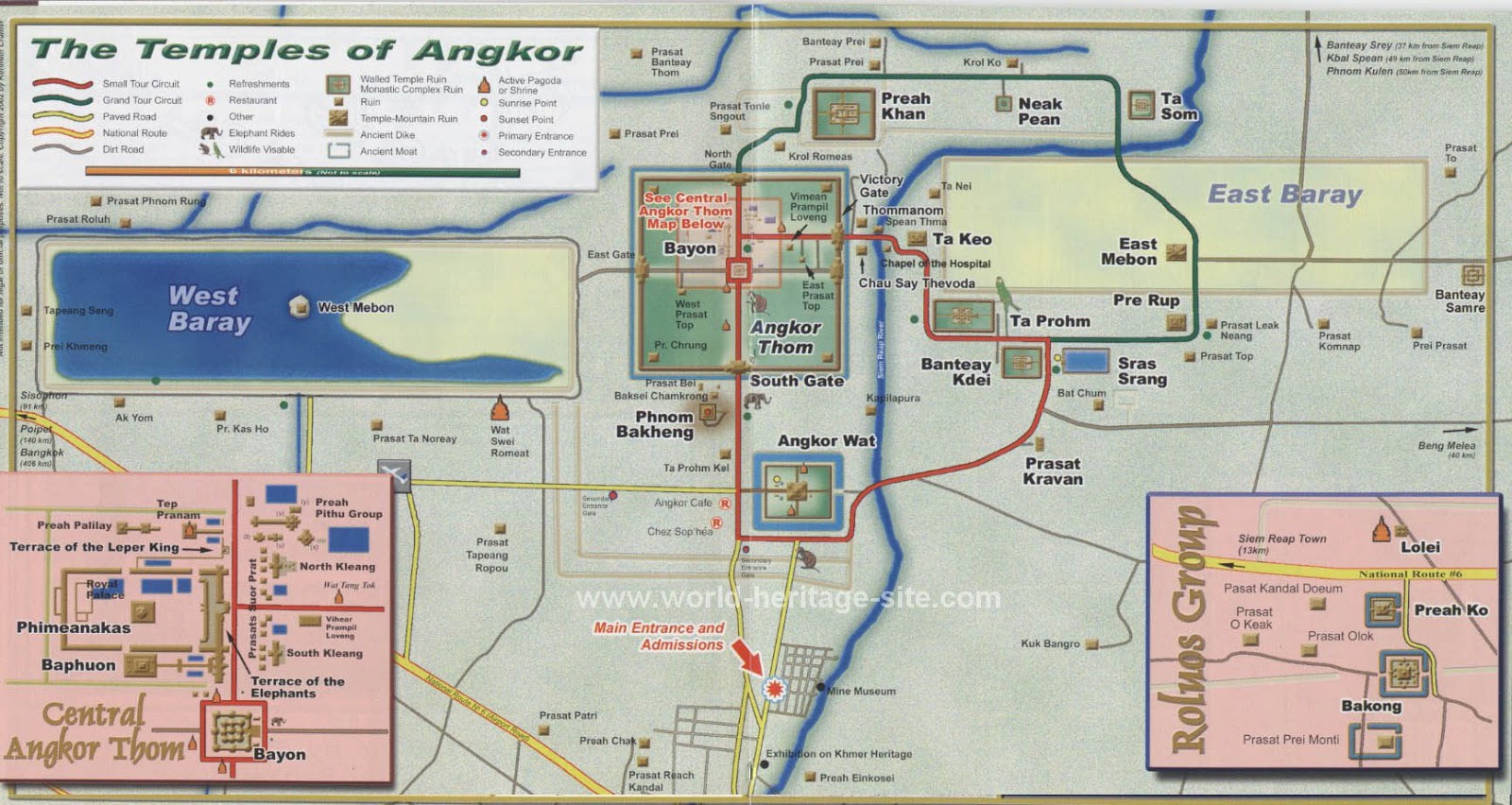
The complex is divided into 4 main sections, Eastern Baray, Western Baray, Angkor Thom and Angkor Wat, with lots of temples scattered in between and on the outskirts. Stay there a month and you still won't see everything. Your first stop was Prasat Kravan! A relatively small 10th century temple consisting of 5 reddish Brick Towers on a common terrace. The temple was dedicated to Vishnu and built in 921 AD. We took some pictures, explored the area briefly and carried on.

Riding along towards Eastern Baray, we unexpectedly came upon a little lake called Srah Srang. The sunlight, reflecting gently off the still water, caught our eyes and put us in a hypnotized trance as we drew near. We couldn't help but stop and sit for a moment, captivated by the lake's peaceful beauty! There was something truly special there as little Cambodian kids bathed and played with each other on the banks. Little shouts of childish laughter, the fresh scent of the murky waters and warm sunlight touching my shoulders, I was awash with an overwhelming sensation of where in the world I currently sat!

Finished, we decided to grab some lunch at the little market just across the street from the lake. Not the best food and grossly overpriced, we ate there anyways as our options were limited.

Banteay Kdei was next and proved to be our introduction to how nature interacts with the man-made beauty of the Angkor structures. It's smaller and less complex than some of the other temples, but it certainly did not seem small to me! Rubble and scattered stone blocks litter the entry way. A massive tree greets you as you enter. Its powerful, yet graceful roots meander along the entry way path, implying who the rightful owner of this temple is! The temple structures are contained within two successive enclosure walls and consist of two concentric galleries from which protrude two massive towers. It's a bit dilapidated due to faulty construction and poor quality limestone, but considering it's still standing after 900 years, I think the Khmer did a pretty good job of putting it together!


   Eastern Baray is a gigantic section of Angkor. Trying to see it all in one day is pointless! Needless to say we were only able to get through about half of it. But on that day, I was awestruck by an absolutely compelling temple. As I mentioned earlier, aside from the genius architecture and the metaphysical wonder of Angkor, there seems to be a beautiful symbiosis between the natural and man-made structures. Ta Phrom, for instance, blew me away! The monstrous trees that are hundreds of years old sit directly on top of the temples with their roots cascading down to the ground, spreading like giant tentacles, putting their claim on whatever happens to be within their grasp. I have never in my life seen anything like this before!

Anyhow, physically exhausted from pedaling all day and emotionally drained from experiencing such magnificent power, we decided to call it a day and return back to town. What we would uncover later that evening was nothing short of exhilarating. After a fulfilling dinner, my buddy and I decided to grab a few drinks at a local bar. It was close to midnight when we got there and what we found was an electricity in the air that rippled through me with giant force. I quickly realized that I was not the only one who felt the intensity of the rich history and succulent flavor of Angkor. All the chatter was infused with passionate accounts of what everyone had experience that day! The dance floor was steamy! Both young and old moved to the rhythm of music, fueled by the intense excitement of finding themselves surrounded by such an opulent piece of history. Everyone was open and friendly and we remained until the wee hours of the morning, engaged in conversation, drinking, laughing and dancing!

I didn't think there could be an equal to what we encountered the first day but it just kept getting better! We woke up early with no ill effects from the previous night's debauchery and headed straight for Angkor. With a little more knowledge about the terrain and energized by the previous day's events this would be the biggest day for exploration! We saw all the major temples of Eastern Baray, including Preah Khan, Nak Pean and Ta Keo. All were magnificent and very impressive, especially Ta Keo. Ta Keo was built in 968 AD, and what was truly striking is just how large it appears when in fact it is quite small. This is an example of the Khleang style, using elaborate perspective effects and absolutely no carving to give it that massive look. Just incredible!

What most people think of when it comes to Angkor is Angkor Wat. If you haven't noticed, that temple has been mentioned only once up to now! Nature is what brings this kingdom together and puts it over the top of most other historical sites on this planet. As we rode our bicycles from temple to temple, I cannot even begin to tell you how many times we stopped in sheer awe and amazement! We were in awe not because of an incredible piece of architecture or a world wonder, but because of simple things like rice fields, streams, the sky, the sounds of the jungle around us, even the tropical rains that swoop in with no warning had a strangely exhilarating appeal. At times, it was magical to ride alongside and meet locals who greet you kindly and are more than happy to share with you a bit of the wonder that Angkor truly is! To hire a taxi would be to miss out on so much as the true magic of Angkor is to be uncovered in a simple, squeaky bicycle ride!

Angkor Thom, meaning the Great City is guarded by Victory gate on the southern entrance! The bridge leading up to the gate is lined by intricately carved demon statues. As creepy as that sounds, the rustic beauty is striking! And being that it's a central passage way into Angkor Thom, you will also see many locals and tourist pass through on bicycles, tuk-tuks and everything in between!

Many people think of Angkor Thom as a massive temple, when in fact it's an entire city! In the center of this once sprawling metropolis stands Bayon, the most famous temple within city limits. It's most recognizable feature is the main terrace where giant, peaceful stone faces cluster around its' central peak! The temple is rustic and looks truly ancient. Massive boulders, giant pillars and intricately carved towers are everywhere. Once you step inside, you are sent back in time and the outside world ceases to exist. We wandered the maze of hallways for hours, playing archaeologists and inspecting the beautiful carvings on the walls. The overall architecture of the place is also a treat! It is perfectly symmetrical. When inside, certain key spots allow you to look onto the main terrace providing you with unobstructed views of the faces and other peculiar points of interest that you otherwise would not have noticed. Really taking the time to explore this temple will give you a sense of what king Jayavarman VII valued most.
BAYON TEMPLE

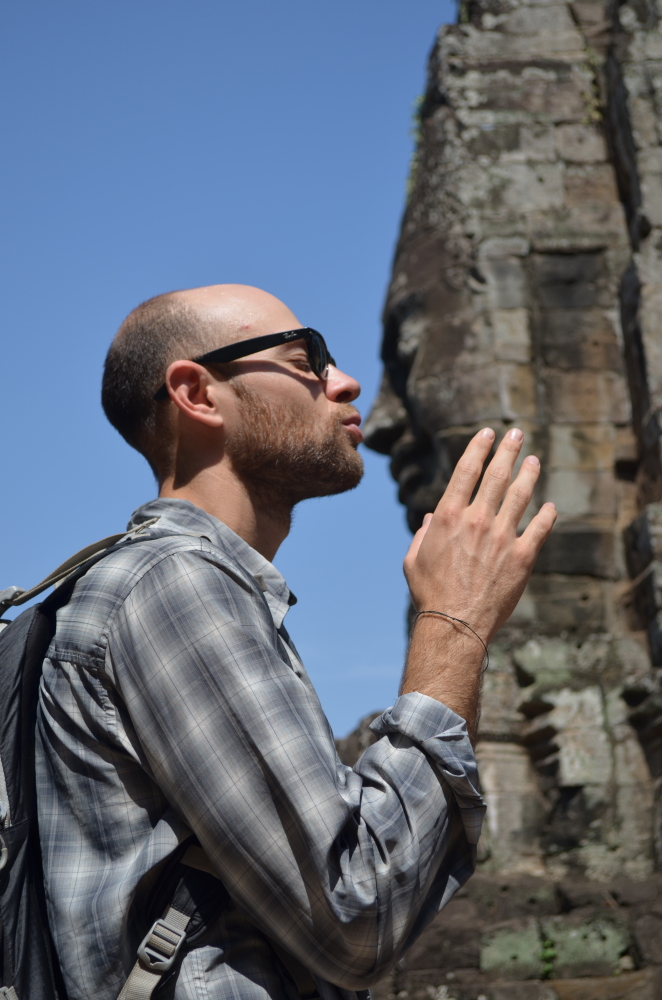
Kissing the Stone Face in Bayon, Angkor Thom

The city took us the rest of the day to explore, but most of our time was spent uncovering Bayon. With the last moments of the day, I found myself sharing a profound moment with a very good friend. While sitting at the top of the beautifully peaceful Bayon, with the sun descending to the backdrop of the jungle, a myriad of peculiar jungle sounds permeated the air. The weather was muggy, but seemed to envelope you as a warm down blanket would, not too hot and certainly not too cold...perfect. Little Cambodian kids rustling at the base of the temple with their parents nearby. There seemed to be an energy that electrified the air! Knowing that tomorrow would be our last day there, we sat until the sun finally set, sharing our hopes for the future and dreams about what's to come. It was truly one of the highlights of the entire Southeast Asian Tour!


Many people say that Angkor Wat must be seen at sunrise so we woke up bright and early, at 5 AM, hired a taxi and sped off. I'll be honest, seeing Angkor Wat in the dark is quite different and very spooky! It's already a gloomy structure, but when lit by the howling moon, that side of it's demeanor is magnified ten-fold! The phrase "the ghosts come out at night" is very appropriate to describe the feeling. A millennium worth of wars, strife, and torment is present there and you can feel it with the force of a bone-chilling thud! The entrance to the temple is the first causeway and historic accounts state that it signifies the movement from hell to earth. I'd say that's appropriate!

Anyhow, by the time the sun began its ascent, the sky was covered in clouds and the effect of a magnificent sunrise was dulled a bit. The main terrace quickly began to fill with tourists. Photographers, tour guides, families and little Cambodian kids selling nick-knacks littered courtyard, making it difficult to soak up the energy of this famous temple. It was almost like being in Disneyland. Nevertheless, we took our time exploring this "temple City," which is what the words "Angkor Wat" actually means. To describe how amazing this temple is, I feel it's best to draw on a quote from Antonio da Magdalena of Portugal who visited the temple in 1586 and consequently became one of the first westerners to do so. This is what he said. It "is of such extraordinary construction that it is not possible to describe it with a pen, particularly since it is like no other building in the world. It has towers and decoration and all the refinements which the human genius can conceive of." The fact that this temple has suffered very little damage and was nicely restored in the 19th century allows me to attest to those beautiful words. It truly is an incredible structure and surely worth a visit wherever in the world you are coming from!

Wednesday, November 18, 2015

THE ANCIENT TEMPLE OF ANGKOR


The Ancient Temples of Angkor

The air travel from Phnom Penh to Seim Reap took just 45 minutes and another 15 to 20 minutes by bus to Angkor Wat. It was wonderful to see how the ancient Indians brought religion, a legal system, a script, astronomy and more, about 1000 years ago to this region. I had read about the miss management of restoration work by the Archeological Survey of India (ASI) at Angkor Wat. Apparently the Indian Government, under Indira Gandhi had agreed to support the restoration work under the DRK government in Cambodia. The ASI apparently used inappropriate material and port land cement and used ill trained labor, causing damage to the structures. The ASI, however, was working under severe constraints during the time of the civil war when both building material and labor were scarce and there was the ever-present threat of war making working conditions most difficult.

We did see a large placard at Angkor Wat near the famous "Churning of the milk" bass relief sculptures, that repairs and corrective work was on to correct for earlier incorrect restoration work. A couple of ASI staffers, who were with us, were quite indignant about reference to miss management and did talk about the difficult conditions under which the work had been carried out during the civil war. They also said that the work of that period, late 70s and 80s, cannot be compared with modern-day restoration practices as major advancements had taken place in restoration techniques. Later on during our visit to the Ta Prom temple, were restoration work was on by ASI, the ASI staff took pains to explain how locally available stones and resins from the trees surrounding the temple were being used in the restoration work, just as they would have over 700 years ago.


                                                                     The Ta Prom temple was almost completely taken over by forests. Many structures had giant trees growing out of them. It made for great and fascinating viewing. This is a very popular temple made unique by the ingress of the forest and the curious juxtaposition of man-made structures and the natural forest, both giant structures. The ASI staff took us through the restoration effort going on at the "Hall of Dances". Considering the state of ruins this hall was in, it did seem a mammoth task to restore. The objective of restoration will be to restore the structures just enough, so that viewers can see partially the glorious structures of the past and just enough to prevent it from total disintegration, when it will be lost forever. .

It was interesting to know that during the reign of the Khmer Kings there was no written records left behind or traceable; even for the reign of Suryavarman 2, the builder and patron of the Angkor Wat city and temple. It was only through painstaking research and breaking of the codes of inscriptions on later temples that the complete linear age and accomplishments of some of the Kings could be unraveled. It is fascinating to read how the jig saw puzzle was put together by groups of dedicated professionals. Some names referred to in literature include,Henri Mouhot, a French Expedition lead by Ernest Doudari de Legree,Dutchman Hendrik Kern who was the first to decipher the Sanskrit inscriptions found in Cambodia and the two Frenchmen, Aguste Barthe and A Bergaigne,who are credited with furthering the field of Khmer epigraphy which lead to the translations of 1200 inscriptions relating to the genealogy of the Khmer Kings. Hats off to these explorers and archaeologists. These individuals reconstructed a bygone age in Cambodia (700 to 1200 AD) and helped build world opinion for the restoration and preservation of these great treasures of humanity.

Each of the four temples we visited, had distinctly different features and each was appealing in its own way. The Bayon Temple in Angkor Thom was characterized by huge images of Bodhisattvas,as this was originally a Mahayana Buddhist temple built by Jayavarman 7th. The temple was converted into a Hindu temple under the reign of Jayavarman 8th and eventually converted into a Theravada Buddhist Temple. Jayavarman 8th was reported to be anti-Buddhist to the extreme and is said to have defaced or removed most of the Buddhist images from the temple. We could see this at the Bayon temple where at several places only recesses remained where earlier Buddhist images would have once been.

       There is an interesting theory about the fall of the Khmer Empire. During the period when the Khmer Empire expanded and established itself as Khambudesa, the Kings were deemed incarnations of Gods as for instances Suryavarman 2nd considered himself as the incarnation of Lord Vishnu. They, therefore had unquestioning loyalty and devotion of the people. Their advanced knowledge of water management techniques also lead to prosperity and the ability to carry out gainful trade. During the influence of Theravada Buddhism, the link between the Divine and the King was snapped; it became more difficult to harness the people for major projects and with the ability to manage water also declining, a gradual decline in affluence and a consequent decline of power and authority of the Dynasty took place. The Khmer Kingdom was gradually pushed down to Phnom Penh before dying away.


While the Angkor Wat temple is the most talked about and also the representative symbol of Cambodia, it was the other temples the Bayon, Ta Prohm and Bantey Streiy which caught my fancy a lot more. You explore experience and discover the beauty and fascination of these great structures in your own unique way. Even with limited knowledge of the archaeological significance of these monuments, you do intuitively take to the structures in your own way and discovered them in your own way.